 +971 52 248 8528
 +966 56 233 0183
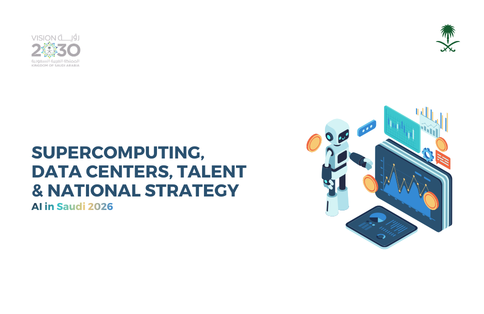


Saudi Arabia’s AI in Saudi transformation has become one of the most closely watched government-led technological initiatives in the world. Through strategic infrastructure development, sovereign capital investments, and coordinated national policies, the Kingdom is building comprehensive artificial intelligence capabilities aligned with its Vision 2030 economic diversification goals.
As of 2026, Saudi Arabia ranks 5th globally for AI sector growth and 1st in the Arab world. This ranking reflects the Kingdom’s rapid investment pace and strong policy coordination rather than absolute AI readiness.
This analysis separates verified infrastructure development, national frameworks, and workforce challenges from speculative narratives around the Saudi AI ecosystem.
1. Saudi Arabia’s Supercomputing Anchor: Shaheen III
One of the most critical elements of AI in Saudi strategy is high-performance computing capacity.
Shaheen III is currently the most powerful supercomputer in the Middle East.
Key Facts
Ranked #18 globally in the TOP500 list announced at SC25 (November 2025)
Built by Hewlett Packard Enterprise using HPE Cray EX architecture
Powered by 2,800 NVIDIA GH200 chips
Delivers 35.6 PF CPU + 122.8 PF GPU performance
This computing capacity enables tens of quadrillions of calculations per second, making it a cornerstone of Saudi Arabia’s AI research infrastructure.
Operational Status
The GPU partition was transferred to Saudi ownership in October 2025 under a U.S. export license
Full deployment and activation are scheduled for early 2026
Strategic AI Research Priorities
Once operational, Shaheen III will support research in:
Arabic-centric large and small language models
Digital twin of the Arabian Peninsula for climate modeling
AI-based remote sensing for natural reserves
Robotic chemistry laboratories for materials discovery
AI diagnostic tools for rare diseases in the Saudi populat
This computational backbone significantly strengthens Saudi Arabia’s ability to build sovereign AI technologies.
2. Saudi Arabia’s Data Center Expansion and the Hexagon Initiative
The AI in Saudi narrative is closely tied to the Kingdom’s massive data center expansion strategy.
Hexagon Data Center
Construction officially began January 2026 under SDAIA (Saudi Data and AI Authority)
Expected to become the world’s largest government-owned data center
480 MW power capacity
Located in Riyadh
Covers 30+ million square feet
The facility will support:
Sovereign cloud infrastructure
Government digital services
National data localization policies
National Data Center Growth
Saudi Arabia’s data center landscape currently includes:
222 MW deployed capacity (Q1 2025)
1.5 GW national capacity target by 2030
Projected $3.9 billion data center market by 2030
Major Industry Contributors
Key organizations contributing to infrastructure growth include:
center3 (STC subsidiary)
$10 billion investment plan
Target: 1 GW capacity by 2030
HUMAIN (PIF-backed technology hub)
$23 billion ecosystem partnerships
Target: 6.6 GW infrastructure capacity by 2034
AMD – Cisco – HUMAIN Joint Venture
1 GW AI infrastructure deployment planned by 2030
Global hyperscale cloud providers including AWS, Microsoft Azure, Google Cloud, and Oracle have also committed regional infrastructure investments.
Engineering Challenges
Operating hyperscale AI data centers in desert environments creates complex engineering challenges including:
Thermal management
Water usage for cooling
Energy optimization
Many of these operational details remain undisclosed publicly.
3. Saudi Arabia’s Strategic Energy Advantage
Energy availability provides Saudi Arabia with a major competitive advantage in AI infrastructure deployment.
Key structural advantages include:
Low-cost domestic electricity
Capability to support 100–500 MW hyperscale data centers
Large renewable energy expansion plans
Saudi Arabia aims to generate 50% of its electricity from renewable energy by 2030, particularly through solar power projects.
Competitive electricity pricing potentially low single-digit cents per kWh is attracting major global hyperscale infrastructure investments.
4. Human Capital and the AI Talent Gap in Saudi Arabia
Infrastructure alone does not define AI leadership. Human capital remains the largest long-term challenge.
SAMAI Program: Scaling AI Skills
The SAMAI program (“One Million Saudis in AI”) has achieved major milestones:
Over 1 million Saudis trained
52% female participation
Participants distributed across:
70% employees
30% students
A new SAMAI 2 phase is targeting specialized AI skills across sectors including:
Healthcare
Finance
Transport
Energy
The AI Talent Gap
Despite these achievements, Saudi Arabia still faces structural workforce gaps.
Key indicators include:
50% hiring gap in AI roles
54% annual increase in AI job postings (2018–2022)
Only 17% of female STEM graduates work in STEM fields
A projected shortage of 663,000 skilled tech workers by 2030
Continued reliance on foreign AI specialists
Strategic Workforce Model
Companies entering Saudi Arabia’s AI sector often adopt hybrid talent strategies, combining:
International senior technical expertise
Local workforce training and leadership development
For example, IBM’s Riyadh software lab has achieved over 70% Saudi nationals in technical roles, demonstrating successful localization.
5. Economic Impact of AI in Saudi Arabia by 2030
Economic forecasts show significant upside for the Saudi AI sector.
Key projections include:
$135.2 billion GDP contribution by 2030 (PwC)
12.4% of Saudi GDP linked to AI technologies
$1.5 billion AI market size in 2025
Expected growth to $6.8 billion by 2030
Generative AI alone could contribute SAR 60–90 billion to the Saudi economy by 2030 according to Oliver Wyman and SDAIA estimates.
Sectoral Impact
AI is expected to transform major industries including:
Healthcare diagnostics
Education personalization
Energy optimization
Logistics and supply chain management
Financial services automation
However, economic value will depend on adoption levels across private sector industries.

6. Saudi Arabia’s Global AI Standing
Global AI performance indicators show strong growth momentum.
Saudi Arabia currently ranks:
#5 globally in AI sector growth rate (Global AI Index)
#1 in the Arab world for AI sector growth
#14 in global AI readiness (UNESCO)
#3 globally for AI hiring growth with 28.7% YoY expansion
These rankings highlight growth trajectory rather than technological parity with AI leaders such as the United States or China.
7. The Three Critical Tests for AI in Saudi by 2030
To fully realize its AI ambitions, Saudi Arabia must succeed in three key areas:
1. Building Advanced Talent Ecosystems
Moving beyond basic AI literacy toward advanced research capabilities and engineering expertise.
2. Expanding Private Sector Adoption
Encouraging companies across industries to integrate AI into operations and services.
3. Sustaining Infrastructure Investment
Maintaining long-term infrastructure development even during oil price fluctuations.
Among these factors, talent development remains the most critical variable for the decade ahead.
Conclusion
The rise of AI in Saudi represents one of the most coordinated national technology strategies in the world.
Verified data confirms:
Massive infrastructure investment
Advanced supercomputing capabilities through Shaheen III
Rapidly expanding data center capacity
Strong projected economic impact
Significant workforce development challenges
Saudi Arabia’s AI transformation is not simply a technology narrative—it is a combination of infrastructure, policy coordination, and human capital development.
The next decade will determine whether the Kingdom can convert this infrastructure advantage into sustained global AI leadership.