 +971 52 248 8528
 +966 56 233 0183
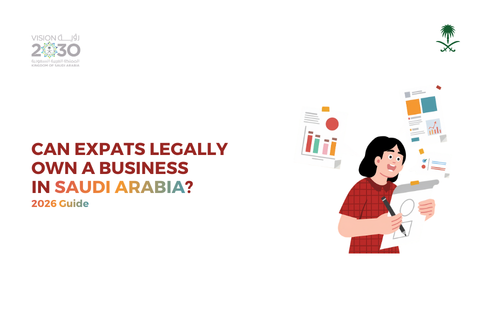


Expats can legally own a business in Saudi Arabia, including 100% foreign ownership in many sectors. Approval is granted through the Ministry of Investment of Saudi Arabia (MISA), subject to activity classification, capital requirements, and regulatory compliance.
In most commercial and professional activities, a Saudi partner is no longer mandatory. These reforms were introduced as part of Saudi Vision 2030 to attract foreign investment and diversify the economy.
What Does Expat Business Ownership Mean in Saudi Arabia?
Expat ownership means a non-Saudi individual or foreign company holds equity in a Saudi-registered entity under foreign investment regulations.
To operate legally:
- A foreign investment license must be issued by MISA
- The company must obtain a Commercial Registration (CR)
- The business must register for taxation and municipal approvals
Foreign ownership is structured, regulated, and fully recognized under Saudi law.
Can Expats Own 100% of a Company?
Yes, in many sectors.
100% foreign ownership is typically allowed in:
- Management and business consulting
- IT and technology services
- E-commerce
- Trading (with capital requirements)
- Industrial and manufacturing projects
However, some sectors remain restricted or require additional approvals. Activity classification is critical before proceeding

Which Authority Approves Foreign Investors?
The primary authority is:
After MISA approval, the company must complete:
- Commercial Registration
- Chamber of Commerce registration
- Tax registration with the Zakat, Tax and Customs Authority
- Municipality/Balady licensing (if required)
MISA approval is the foundation of expat business ownership.
What Business Structures Are Available to Expats?
1. Limited Liability Company (LLC)
The most common structure. Suitable for trading, consulting, services, and general commercial activities.
2. Branch of a Foreign Company
Ideal for established international companies entering the Saudi market.
3. Joint Venture
Used when partnering strategically with Saudi entities for market access or regulatory alignment.
The choice depends on capital strategy, liability management, and long-term growth plans.
What Are the Capital Requirements?
Capital requirements vary depending on the business activity.
For example:
- Professional services typically require lower capital
- Trading activities may require higher minimum capital
- Industrial projects depend on scale and licensing category
Capital must be declared, and in certain cases, deposited according to regulatory requirements.
A proper capital structure strengthens both compliance and credibility.
Step-by-Step Process for Expats to Start a Business
- Define the business activity
- Apply for a foreign investment license through MISA
- Draft and notarize Articles of Association
- Obtain Commercial Registration (CR)
- Secure an office lease
- Register with ZATCA
- Apply for municipal licenses (if required)
- Open a corporate bank account
- Apply for investor and employee visa.
Each step must align precisely with the approved activity.
Why Did Saudi Arabia Introduce 100% Foreign Ownership?
The shift away from mandatory sponsorship was implemented under Saudi Vision 2030.
Key objectives include:
- Increasing Foreign Direct Investment (FDI)
- Strengthening private sector growth
- Encouraging technology and knowledge transfer
- Attracting international entrepreneurs
- Improving global competitiveness
This reform has significantly improved investor confidence and ease of doing business.
Common Mistakes Expats Should Avoid
- Choosing the wrong business activity
- Assuming all sectors allow 100% ownership
- Not meeting capital thresholds
- Signing a lease before license approval
- Ignoring Saudization workforce requirements
Improper structuring can lead to delays, rejections, or compliance penalties.

Quick Summary
- Expats can legally own businesses in Saudi Arabia
- 100% ownership is allowed in many sectors
- Approval is issued by the Ministry of Investment of Saudi Arabia
- Capital requirements depend on business activity
- Tax registration is completed with the Zakat, Tax and Customs Authority
- Reform driven by Saudi Vision 2030
Final Insight for Investors
Saudi Arabia has transitioned from a sponsor-based framework to a regulated foreign investment system.
For serious entrepreneurs, the question is no longer whether expats can own a business, it is how to structure that ownership for long-term scalability, compliance stability, and market expansion.