 +971 52 248 8528
 +966 56 233 0183
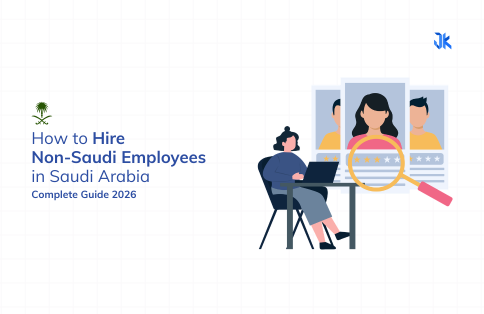





Saudi Arabia has become one of the most attractive markets in the world for international businesses, driven by Vision 2030, major infrastructure projects, industrial development, tourism, technology, healthcare, logistics and the rapid expansion of the private sector.
For companies operating in the Kingdom, hiring qualified international employees can be an important part of building a successful business.
However, employing a non-Saudi national is not simply a matter of obtaining a visa. The employer must comply with requirements relating to the company’s eligibility, recruitment quota, Nitaqat, employment contracts, work permits, residency, medical insurance, wage protection and social insurance.
This guide explains the major steps involved in hiring non-Saudi employees in Saudi Arabia and provides links to the principal government platforms that employers should use.
Important: Saudi employment regulations and platform requirements can change. Employers should always verify the current requirements and fees on the relevant government platform before submitting an application.
1. What Is the Process for Hiring a Non-Saudi Employee?
There are generally two main routes:
Route 1 — Hiring a Non-Saudi Employee Already Inside Saudi Arabia
If the candidate is already working in Saudi Arabia, the employer may use the Employee Transfer service on Qiwa.
The employee transfer system allows an employer to recruit a non-Saudi employee working for another Saudi establishment, subject to the applicable eligibility and establishment requirements.
Qiwa states that the establishment must, among other things, be active, have an active Commercial Registration where applicable, comply with the Wage Protection System, maintain the required Nitaqat status and have valid work permits for employees within the relevant establishment group.
Route 2 — Hiring a Non-Saudi Employee From Outside Saudi Arabia
For a candidate located outside the Kingdom, the employer normally proceeds through the work-visa process.
Qiwa provides services for permanent work visas as well as certain temporary work visas. The employer must satisfy the applicable eligibility requirements and have sufficient recruitment quota.
2. Step One: Make Sure Your Saudi Company Is Eligible
Before recruiting a foreign employee, the company should first verify its status on Qiwa.
Important factors can include:
- Active establishment status
- Valid Commercial Registration, where applicable
- Valid work permits for employees within the establishment group
- Compliance with the Wage Protection System
- Appropriate Nitaqat classification
- Available recruitment quota
- Compliance with applicable business activities
- Employee location information on Qiwa
- Annual self-evaluation requirements where applicable
- Sufficient balance on relevant Ministry of Interior platforms
For permanent work visas, Qiwa currently identifies requirements including a valid establishment, valid CR where applicable, at least the required Nitaqat level, WPS compliance, contract authentication compliance, sufficient Ministry of Interior platform balance and available recruitment quota.
Employers should therefore check company eligibility before promising a visa to a candidate.
3. Understanding Nitaqat and Saudization
One of the most important considerations when hiring non-Saudi employees is the company’s Saudization/Nitaqat position.
Nitaqat is the Kingdom’s localization framework that regulates the employment of Saudi nationals in the private sector.
Your company’s Nitaqat position can influence the ability to recruit or transfer non-Saudi employees.
The required localization percentage can vary according to factors such as:
- Economic activity
- Company size
- Workforce composition
- Occupations
- Applicable localization decisions
Qiwa provides tools that allow establishments to review their Nitaqat position and recruitment-related information.
Practical advice: Before recruiting an expatriate, check the company’s Nitaqat status and available recruitment quota rather than assuming that a new visa will automatically be available.
4. Recruitment Quota
Recruitment quota is another important factor.
The quota determines the number of permanent work visas and, in relevant circumstances, employee transfers that an establishment can request.
Qiwa provides a Work Permit Calculator and recruitment-related tools to help businesses assess their position.
The available quota may depend on the company’s size, activity, workforce composition, Nitaqat status and other regulatory requirements.
5. Hiring an Employee Already Inside Saudi Arabia
If the candidate is already employed in Saudi Arabia, the employer can consider the Qiwa Employee Transfer service.
The process generally involves:
- Identifying the candidate.
- Checking the candidate’s transfer eligibility.
- Checking the new employer’s eligibility.
- Initiating the employee transfer request through Qiwa.
- Creating/submitting the employment contract.
- Obtaining the required approvals.
- Completing the transfer.
- Updating the employee’s employment and insurance records.
Qiwa states that candidates holding a Final Exit Visa or Final Exit Work Permit are not eligible for the relevant employee-transfer route.
6. Hiring an Employee From Outside Saudi Arabia
If the candidate is outside the Kingdom, the employer can use the applicable work visa service through Qiwa.
Permanent work visas are intended for long-term employment.
Qiwa also provides temporary work visas for eligible short-term arrangements. Qiwa describes temporary work visas as being used for contracts of three months or less, subject to the applicable requirements.
For permanent work visas, the employer should first verify:
- Establishment eligibility
- Nitaqat status
- Recruitment quota
- Work permit status
- WPS compliance
- Contract authentication compliance
- Ministry of Interior platform balance
- Employee occupation and skill requirements
7. Work Permit Classification and Employee Skills
Saudi Arabia has introduced a work-permit classification system for non-Saudi workers based on skill categories.
The three categories are:
High-Skilled
For employees meeting the relevant educational, professional experience, skills, remuneration and age criteria.
Skilled
For employees meeting the applicable skilled-worker requirements.
Basic
For occupations classified under the basic skill category.
Qiwa states that the classification considers factors including:
- Educational qualifications
- Professional experience
- Professional skills
- Remuneration
- Age
The classification system began implementation in phases in 2025, including classification of existing workers and incoming workers.
This makes it increasingly important for employers to ensure that the employee’s occupation, qualifications, experience and employment contract are correctly aligned.
8. Employment Contract Through Qiwa
Once the candidate has been selected, the employer must create the employment contract through Qiwa.
The Qiwa contract process allows employers to enter information such as:
- Employee details
- Job title
- Contract type
- Contract duration
- Start date
- Notice period
- Probation period
- Working hours
- Annual leave
- Basic salary
- Allowances
- Housing allowance
- Transportation allowance
- Additional contractual clauses
Qiwa states that employment contracts created through its platform are authenticated electronically after the employee’s approval.
Employee Approval
The employee receives the contract through their individual Qiwa account.
Qiwa currently states that the employee has a limited period to review the contract, and non-response can result in automatic cancellation of the request.
For a non-Saudi employee already inside Saudi Arabia, the employment contract may also need to be accompanied by an Employee Transfer Request.
9. Work Permit Issuance
A non-Saudi employee generally requires a valid work permit to legally work for the Saudi employer.
Qiwa provides the electronic Work Permit service.
Work permits can be issued or renewed through the employer’s Qiwa account, subject to the applicable requirements.
The duration and applicable fees depend on the circumstances, employee and employer status, occupation and current government rules.
Employers should use the official Qiwa calculator and service interface rather than relying on outdated fee schedules published elsewhere.
10. Medical Insurance
Medical insurance is a key requirement when employing non-Saudi employees in Saudi Arabia.
The Council of Health Insurance states that employers are responsible for providing mandatory cooperative health insurance for employees covered by the system and their eligible family members.
The Council also states that insurance coverage for non-Saudi employees begins from the date of transfer of sponsorship or entry into Saudi Arabia, subject to the applicable timing requirements.
Employers should ensure that the employee’s insurance is active before proceeding with the relevant residency process.
11. Iqama / Saudi Residency
After the employee enters Saudi Arabia through the appropriate employment route, the employer must complete the relevant residency procedures.
The employee’s Iqama, or Saudi Resident Identity, is an essential document for legal residence and employment in the Kingdom.
Relevant residency and immigration processes are connected with Ministry of Interior systems and platforms such as Muqeem.
Employers should monitor:
- Iqama validity
- Passport validity
- Work permit validity
- Health insurance
- Exit/re-entry requirements
- Final exit requirements
- Employee data
- Dependent information where applicable
12. GOSI Registration
Employers must also ensure that the employee’s social insurance records are properly handled.
The General Organization for Social Insurance (GOSI) provides specific processes for registering non-Saudi employees.
GOSI states that non-Saudi employees entering Saudi Arabia or transferred to an employer can be registered automatically based on the relevant official records, with the employer required to complete the relevant information within the prescribed period.
Employers should regularly reconcile:
- Qiwa employee records
- GOSI records
- Payroll
- Employment contracts
- Work permits
- Iqama information
Differences between government records can create compliance issues.
13. Wage Protection System – Mudad
Saudi employers must comply with the Wage Protection Program.
The system monitors salary payments and helps ensure that employees receive their wages according to the contractual terms.
The Ministry of Human Resources and Social Development states that Wage Protection files are now submitted through the Mudad platform.
WPS compliance is also important because Qiwa identifies Wage Protection compliance as one of the requirements relevant to several expatriate recruitment and transfer services.
Therefore, hiring expatriates is not only about obtaining a visa; the employer must maintain ongoing payroll compliance after the employee joins.
14. Salary and Contractual Compliance
Salary should be paid according to the documented employment contract and applicable Saudi labour regulations.
The Kingdom has also strengthened the legal status of documented employment contracts.
In 2025, the Ministry of Human Resources and Social Development announced integration between Qiwa, Mudad and the Ministry of Justice’s Najiz platform relating to documented employment contracts and enforcement of wage clauses.
This means employers should take employment contracts and payroll compliance seriously.
A contract should not simply be created to obtain a visa and then ignored after the employee starts work.
15. Ministry of Human Resources and Social Development
The Ministry of Human Resources and Social Development (HRSD) is one of the principal regulators of the Saudi labour market.
Its responsibilities include labour regulations, employment policies, Saudization, Wage Protection and various employer and employee services.
Ministry of Human Resources and Social Development
Employers should regularly monitor HRSD announcements because labour-market policies and localization requirements can change.
16. Important Government Platforms for Saudi Employers
| Platform | Main Purpose |
|---|---|
| Qiwa | Employment contracts, work permits, employee transfers, visas, Nitaqat and labour services |
| HRSD | Labour regulations and Ministry services |
| GOSI | Social insurance and employee registration |
| Mudad | Wage Protection and payroll compliance |
| Muqeem | Residency and expatriate-related services |
| Ministry of Interior | Immigration and residency-related matters |
| Council of Health Insurance | Mandatory health insurance compliance |
| ZATCA | Tax, VAT and other tax administration |
| Najiz | Ministry of Justice services and legal enforcement |
| SPL / National Address | National address and business location services |
17. ZATCA and Tax Compliance
Hiring employees also has implications for the company’s accounting and tax compliance.
The Zakat, Tax and Customs Authority (ZATCA) administers Saudi Arabia’s tax and zakat systems.
Employers should ensure that payroll, accounting and payments are properly recorded.
It is also important to distinguish between:
Employee salary payments and payments made to non-resident companies or individuals for services.
ZATCA’s withholding-tax rules can apply to certain payments made by a Saudi resident to a non-resident.
Businesses should therefore obtain professional tax advice where cross-border payments are involved.

18. Common Mistakes Employers Should Avoid
Mistake 1: Promising a Visa Before Checking the Company’s Quota
A company may have an active CR but still face restrictions related to recruitment quota, Nitaqat or compliance.
Mistake 2: Choosing the Wrong Occupation
The employee’s occupation should accurately reflect the actual role and applicable professional requirements.
Mistake 3: Ignoring Work-Permit Classification
The employee’s qualifications, experience, skills, salary and occupation can affect the applicable classification.
Mistake 4: Delaying Employment-Contract Authentication
The employment contract should be correctly documented through Qiwa.
Mistake 5: Not Arranging Medical Insurance
Health insurance is an important requirement for expatriate employees.
Mistake 6: Ignoring GOSI Records
Qiwa, GOSI, payroll and employee records should be reconciled.
Mistake 7: Failing to Comply With WPS
Salary payments and wage files must be managed properly through the applicable systems.
Mistake 8: Treating Iqama Renewal as a Last-Minute Task
Employers should maintain a renewal calendar for:
- Iqama
- Work permit
- Passport
- Health insurance
- Employment contract
- Other regulatory obligations
19. Recommended Expatriate Hiring Workflow
For a company hiring a non-Saudi employee, we recommend the following workflow:
Step 1: Confirm the employee’s nationality, profession and qualifications.
Step 2: Check whether the candidate is inside or outside Saudi Arabia.
Step 3: Review the company’s Qiwa status.
Step 4: Check Nitaqat and recruitment quota.
Step 5: Verify the occupation and applicable skill classification.
Step 6: If the candidate is inside Saudi Arabia, check Employee Transfer eligibility.
Step 7: If the candidate is outside Saudi Arabia, apply through the appropriate work visa route.
Step 8: Prepare the employment contract through Qiwa.
Step 9: Obtain the employee’s approval.
Step 10: Complete the applicable work permit process.
Step 11: Arrange mandatory medical insurance.
Step 12: Complete Iqama/residency procedures.
Step 13: Ensure GOSI records are updated.
Step 14: Add the employee to payroll.
Step 15: Maintain Mudad/Wage Protection compliance.
Step 16: Monitor renewals and ongoing labour-law compliance.
20. Expatriate Employee Compliance After Hiring
Hiring is only the beginning.
Saudi employers should maintain an ongoing compliance system covering:
Employee Documents
- Passport
- Iqama
- Work permit
- Employment contract
- Medical insurance
- Professional certificates where applicable
Government Platforms
- Qiwa
- GOSI
- Mudad
- Muqeem
- Ministry of Interior systems
- Council of Health Insurance
Payroll
- Salary payments
- Wage Protection
- Allowances
- Deductions
- Leave records
- End-of-service calculations
Corporate Compliance
- Nitaqat
- Saudization
- Labour-law compliance
- Employee occupation accuracy
- Contract authentication
- Government fees and renewals
21. Official Saudi Government Links
22. Why Professional Support Matters
For international investors and growing companies, Saudi employment compliance can become complicated because several government systems are interconnected.
A company may have a valid Commercial Registration but still be unable to recruit a particular expatriate because of:
- Nitaqat restrictions
- Recruitment quota
- Occupation restrictions
- Work-permit requirements
- Contract issues
- WPS violations
- Expired work permits
- Missing insurance
- Employee eligibility
- Immigration or residency issues
The safest approach is to check the complete compliance position before starting recruitment.
How J K Management Consultancies Can Help
At J K Management Consultancies, we assist international investors and Saudi companies with the practical administration of establishing and operating businesses in Saudi Arabia.
Our support can include:
- Saudi company formation
- MISA-related business setup
- Commercial Registration
- Qiwa setup and labour services
- Expatriate employee visa processing
- Work permits
- Employee transfer procedures
- Iqama issuance and renewal
- Medical insurance coordination
- GOSI registration support
- Mudad/Wage Protection support
- Government portal management
- PRO/GRO services
- Corporate compliance support
For international investors entering Saudi Arabia, our objective is not simply to establish the company, but to help build a compliant and operational business structure.
Start Your Saudi Business Journey With the Right Structure.
J K Management Consultancies
Saudi Arabia | UAE | International Business Setup & Corporate Services