 +971 52 248 8528
 +966 56 233 0183


Saudi Arabia today stands at a defining moment in its economic history. The Kingdom is no longer perceived solely as an energy-driven economy, but as a rapidly diversifying nation actively unlocking its full commercial, cultural, and geographic potential. This transformation is visible across sectors entertainment, tourism, manufacturing, mining, sports, and culture and is anchored by a decisive policy framework under Vision 2030.
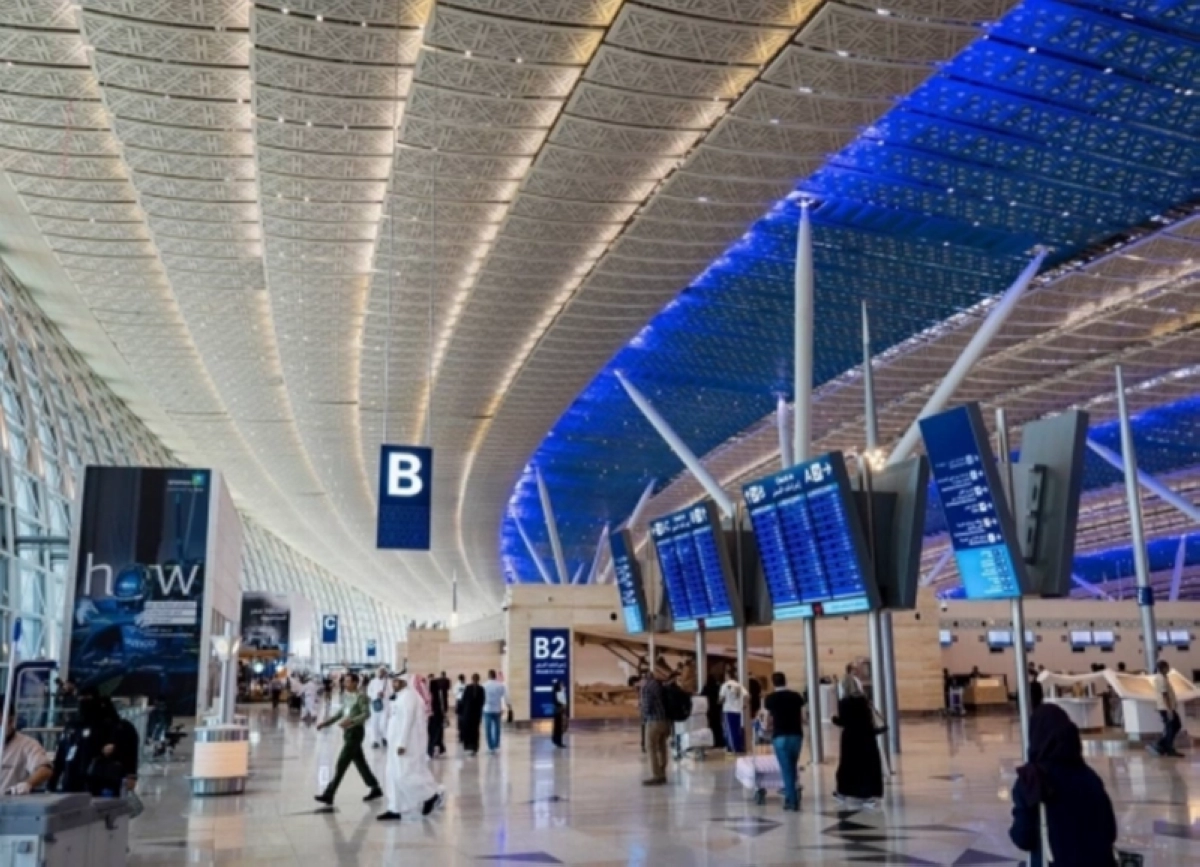
At the heart of this transformation lies a single, powerful enabler: connectivity. From land and sea routes to air corridors linking Asia, Africa, and Europe, Saudi Arabia is rebuilding its historical role as a crossroads of global trade and movement.
A Policy-Driven Shift: From Resource Economy to Networked Economy
Saudi Arabia’s recent policy decisions, MoUs, giga-projects, and sectoral programs reflect a long-term strategic shift. Government-led initiatives are not isolated efforts; they are interconnected moves designed to widen economic participation, accelerate capital flows, and attract global businesses.
Key initiatives supporting this shift include:
- Vision 2030 national transformation programs
- Made in Saudi initiative promoting manufacturing and exports
- Tourism acceleration programs and global promotional campaigns
- Entertainment, sports, and cultural festivals attracting international footfall
- Mining and allied sector liberalization
All these initiatives converge at one strategic requirement: efficient, multi-modal connectivity.
Maritime Connectivity: Ports as Strategic Economic Assets
Saudi Arabia’s maritime infrastructure has become a cornerstone of its global trade ambitions. With coastlines on both the Red Sea and the Arabian Gulf, the Kingdom is uniquely positioned along some of the world’s most critical shipping lanes.
Regional and International Port Integration
Through the Saudi Ports Authority (MAWANI), the Kingdom has strengthened:
- Regional maritime connectivity with Qatar, Bahrain, and the UAE
- End-to-end shipping links with major global trade partners, including China
- Red Sea access supporting Europe–Asia trade via the Suez corridor
These ports are no longer passive transit points. They are evolving into integrated logistics and industrial ecosystems, supporting manufacturing exports, bonded warehousing, and value-added services aligned with the Made in Saudi initiative.
Historically, the Arabian Peninsula served as a vital node on ancient trade routes connecting East Africa, South Asia, and the Levant. Vision 2030 revives this legacy, this time with digital ports, smart logistics, and industrial clusters.
Land and Rail Connectivity: Strengthening the Regional Spine
Parallel to maritime development, Saudi Arabia is expanding its rail and land connectivity, reinforcing internal cohesion and regional trade flows.
Rail projects are designed to:
- Connect industrial zones with ports
- Reduce logistics costs for bulk commodities, mining outputs, and manufactured goods
- Enable faster movement of people and goods across regions
Proposed cross-border rail links, including routes connecting the GCC, signal a renewed focus on regional economic integration, echoing the Kingdom’s ambition to function as the logistical backbone of the Middle East.
Strategic Corridors with India and Singapore
India–Saudi Arabia: A High-Growth Economic Corridor
India is one of Saudi Arabia’s most important strategic partners across labor, tourism, trade, and entrepreneurship. Expanded air connectivity with Indian metro cities and regional airports has enabled:
• Greater business travel and leadership engagement
• Rising tourist arrivals supporting retail and hospitality sectors
• Easier movement of skilled professionals and entrepreneurs
This corridor strengthens bilateral trade and gives Saudi Arabia deeper access to one of the world’s fastest-growing consumer and innovation economies.
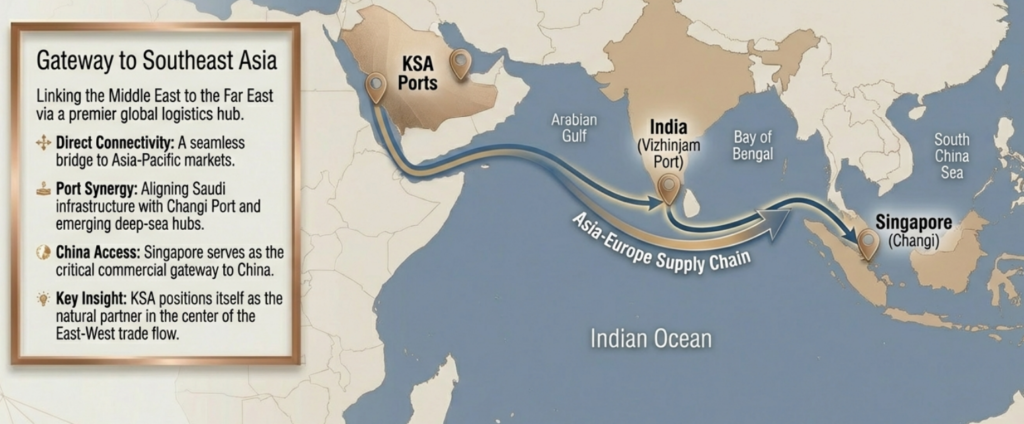
Singapore–Saudi Arabia: Gateway to Asia-Pacific Trade
Direct air connectivity with Singapore carries strategic importance beyond passenger volumes. Singapore serves as:
• A global financial and business hub
• One of the world’s most critical seaports
• A key gateway to East and Southeast Asia, including China via the South China Sea
These air links create a seamless bridge between the Middle East and Asia-Pacific markets. When combined with maritime routes through Singapore and emerging Indian infrastructure such as the Vizhinjam deep-sea port, Saudi Arabia strengthens its role in multi-modal, cross-regional supply chains, positioning itself as a natural partner in Asia–Middle East–Europe trade flows.
Tourism, Culture, and the Power of Movement
Saudi Arabia’s tourism strategy is deeply intertwined with connectivity. Global festivals, cultural programs, and heritage revival initiatives including AlUla cultural programs, dates festivals, archaeological site promotions, entertainment seasons, and major sporting events are drawing international attention.
Efficient air, land, and sea access ensures that:
- Cultural tourism scales sustainably
- Regional and international visitors move easily
- Tourism-driven SMEs and services flourish
Tourism is no longer a soft sector, it is a serious economic engine supported by infrastructure, policy, and global access.

Connectivity as a Competitive Advantage
Connectivity is not an operational detail, it is a competitive advantage.
Saudi Arabia’s strategy demonstrates:
- Long-term policy coherence
- Alignment between geography, infrastructure, and economic goals
- A revival of historical trade logic using modern systems
Businesses evaluating expansion or market entry increasingly assess not just incentives, but how efficiently capital, people, and goods can move. On this metric, Saudi Arabia is rapidly closing gaps with established global hubs such as Dubai and Singapore while offering scale, policy support, and growth potential.
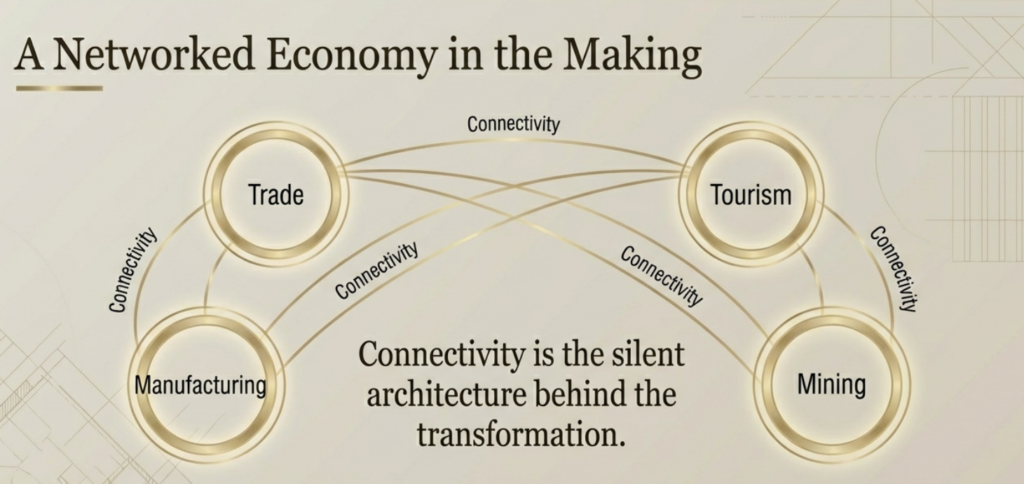
Conclusion: A Networked Economy in the Making
Saudi Arabia’s Vision 2030 is ultimately about building a networked economy, one where trade routes, air corridors, rail lines, cultural exchanges, and business flows reinforce each other.
Connectivity is the silent architecture behind this transformation. For global businesses, investors, and strategic decision-makers, the message is clear: Saudi Arabia is not just opening up, it is connecting itself to the world with intent, scale, and foresight.
Those who understand these patterns early will be best positioned to grow alongside the Kingdom’s next economic chapter.